Tuesday, January 29, 2019

#274 DON'T GIVE IN by Leon Patillo (1981)

DON'T GIVE IN by Leon Patillo (1981)
Myrrh | MSB-6662


Producer:
Skip Konte


File Under: CCM/Funk/R&B


Time Capsule-Worthy Track:
Star of the Morning


Leon Patillo has always struck me as a smooth, happy, funky dude. 

The son of a taxi driver, Patillo was born and raised in San Francisco. His pre-school teacher noticed his interest in music and suggested piano lessons for Leon when he was just four years old. The lessons worked. Patillo joined the choir at his Methodist church as a teenager and also played in a band called the VIPs, performing for local parties and dances. After finishing his education at San Francisco City College, Patillo formed a band called Leon's Creation, later shortening the name to just Creation. 


Creation got a deal with Atlantic Records and often served as the opening act for the band War. Leon moved from San Francisco to Los Angeles and found work as a backing vocalist and arranger for artists like Funkadelic, the Vandellas, and the Pointer Sisters. One day in 1973 Carlos Santana heard Leon sing on a demo tape and invited him to join Santana.  


Leon Patillo (third from the right) with Santana


As best can be determined, Leon Patillo toured with Santana for parts of four years and appeared on 2 or 3 of the group's albums, serving as a singer, keyboard player, and songwriter for the popular secular band. Patillo had become a Christian in 1974 and his newfound faith began to create a conflict within himself as he became increasingly uncomfortable with the lyrics he was expected to sing with Santana. The story is that Leon was fired from the band after a tour in 1977 because Carlos Santana wasn't happy with his performance. Patillo says the real reason is that he was actively (and successfully) witnessing to other musicians on the band's tours. "Lots of people were becoming Christians, but nobody was becoming Buddhist," Patillo said.

So Leon then got involved with Calvary Chapel in Costa Mesa, California and Maranatha Music. The result was 1979's Dance, Children, Dance.  


Patillo was initially billed as another big secular star (think: B.J. Thomas, Joe English, Dan Peek) who was leaving the dark side to become one of us. This was a bit of a risky strategy because Patillo was never a major part of Santana. Eventually, Patillo's record companies dropped Santana as part of the marketing plan and just let Leon's music speak for itself...which worked out great, since Patillo enjoyed good sales figures, fourteen charting singles and a Dove Award over the course of his CCM career.


Dance Children Dance sported memorable cover art by Larry McAdams. The album was full of life and showcased rhythms that were somewhat fresh and new. It's been called CCM's first dance record. Patillo played virtually every instrument on the album. Songs like Born Again, Temple to the Sky and the title track became hits.

Don't Give In
was Patillo's sophomore release and certainly did nothing to slow his momentum, despite the garish cover design (someone got a little too happy with the neon effect).


Don't Give In delivered some huge hits. 

Flesh of My Flesh became one of the most iconic Christian wedding songs of the 80s (and beyond). Author Mark Allan Powell said Flesh of My Flesh became "one of Patillo's most enduring and popular" songs. 

It's almost impossible to read these words without hearing that familiar melody in your head...

You are flesh of my flesh, bone of my bone
There's no one closer
You are flesh of my flesh, bone of my bone
We are one

I do give my life to you
Today and every day
I will stand right by your side
Whatever comes our way
I have searched and searched for someone
Who'd make my dreams come true
Nowhere else on this earth
Is there anyone like you


Jackie and Leon Patillo in the 1970s


Sadly, Patillo's own marriage did not survive. His ex-wife Jackie worked in various positions for record companies like Star Song and Benson and today is president and executive director of the Gospel Music Association, according to her website. Patillo remarried in 1999 and if Facebook posts are to be believed, he and his wife Renee are still deliriously happy. Renee works in the family business, serving as CEO and co-founder of Patillo's S.I.N.G. Foundation.


Leon & Renee Patillo


Leon Patillo blamed himself for the breakup of his first marriage, saying that he was guilty of putting ministry ahead of family. A divorce is always painful, regardless of the reasons why and irrespective of who's to blame. But a divorce is especially embarrassing when you've written lyrics like Others try and separate us / But they don't stand a chance and The storms of life can blow and blow But they won't knock us down / We'll stand the test, the test of time / 'Cause we stand on holy ground. Sometimes I think Satan works overtime to try to destroy marriages of those who've effectively ministered to the marriages of others. With songs like Flesh of My Flesh, Security and Treat Her Like A Lady, Leon Patillo ministered to other couples in a powerful and meaningful way. In so doing, he might've unknowingly made his own marriage a target.


Star of the Morning was another favorite from this album. It was half worship anthem/half history lesson, focusing on the crucifixion and resurrection of Jesus. 

All of creation sings, Star of the Morning
Praise to the risen King, Star of the Morning

People shouted, "Here comes the King!"
As You marched down the road to Jerusalem
There were tears in Your eyes
The same ones who cheered, yelled, "Crucify!"

I lift my hands to Thee, Star of the Morning
You gave Your life for me, Star of the Morning

When they nailed You to the tree
They thought they had won a mighty victory
But not even death could hold You down
On that third day, You rose from the ground

Hallelujah...

One day soon we'll look on high
And the angels of God will light up the sky
What a day that will be
When Jesus our Lord comes for you and me

Star of the Morning went all the way to #2 on CCM radio airplay charts. It would rightfully belong on any Leon Patillo greatest hits collection.


Interestingly, Patillo offered two secular covers on this album - (Your Love is Lifting Me) Higher and Higher, originally popularized by Jackie Wilson in the 60s and Rita Coolidge in the 70s; and My Sweet Lord, made popular by Geoge Harrison. In each case, Patillo makes the song his own with some musical tweaks and sings it from a Christian perspective. This is especially important in the case of My Sweet Lord (the Hare Krishna references would've been somewhat confusing on a CCM album). By the way, Patillo wasn't the first Christian artist to try to "redeem" My Sweet Lord; Larry Norman holds that distinction.


Don't Give In was produced by Skip Konte; the album was recorded, mixed and mastered at International Automated Media. Dennis Hill supplied art direction and Alan Bergman took the photos. 

Background vocals were supplied by Fred Field, Mickey Rooney Jr., Donn Thomas, Denny Correll, and Denny's younger brother Tim (among others). Charlie Souza played bass, Gaylord Birch played drums, and Leon Patillo played all the keyboards. The record was engineered by Brook Johnson and Willie Harlan, mastered by Richard Donaldson, and mixed by Willie Harlan. The tracks were orchestrated by Dave Garland.

Don't Give In ends with a song that has been a missions anthem over the years, simply entitled Go. This song also served as the title track of an album by Shirley Caeser, also released in 1981. But these powerful words, echoing the Great Commission, were penned by Leon Patillo:

Go ye therefore and teach all nations, go, go, go
Baptizing them in the Name of the Father,
And Son, and Holy Ghost, go, go, go

If you love Me, really love Me, feed My sheep
And lo, I'll be with You forever and ever
Until the end of the world, go, go, go


Leon Patillo was just getting warmed up. He would release eight more albums, the last one coming in 2005. He's always been a multi-talented performer (singer/songwriter, keyboardist, dancer, TV host). And he's still active in music ministry today. Patillo has always seen himself as an encourager, with a reach that crosses age barriers and ethnic lines. His music has definitely brought joy to the hearts of many people over the decades. 


Fun fact: Leon Patillo led Phillip Bailey to the Lord when Santana was on tour with Earth, Wind and Fire.

Monday, January 21, 2019

#275 A SONG IN THE NIGHT by Silverwind (1982)

A SONG IN THE NIGHT by Silverwind (1982)
Sparrow Records  |  SPR 1058


Producers:
Georgian Banov, Larry Muhoberac, Tony Salerno


File Under: Euro-Pop CCM


Time Capsule-Worthy Track:
A Song in the Night


The music of Silverwind was a breath of fresh air in the early 80s. Musical comparisons were made to the European secular group Abba and, while I'm no expert on the music of Abba, I suppose there were some similarities. Silverwind was also compared to another famous trio known as the 2nd Chapter of Acts, but that comparison didn't work as well. The 2nd Chapter was in a league of their own with a unique sound and a unique ministry. But playing the comparison game also sold Silverwind short. They deserved to be evaluated and appreciated for what they brought to the table. 


Georgian Banov was a professionally trained musician who began playing violin as a child prodigy in Bulgaria. In the 1960s, he was the founder of the first officially recognized rock band from that communist country before escaping to the United States in 1973. Initially demoralized by the San Francisco drug culture, Banov eventually met other like-minded believers and became heavily involved with ministries known as Candle and Agape Force. In 1980, in Tacoma, Washington, Banov formed Silverwind with two other members of Candle - Betsy Hernandez and Patty Gramling.


The group brought a fresh, Euro-pop sound to CCM that was well-received. Taking the Narrow Street and Never Had a Reason were standout tracks from the group's self-titled debut in 1981. Never Had a Reason was the only song to chart from that record, peaking at #8 on CCM airplay charts in 1982.

With the element of surprise now off the table, CCM listeners waited expectantly for Silverwind's sophomore offering. It did not disappoint.


Unlike the debut album, this one sported a dark color scheme on the record jacket. But the music was still light, breezy, synth-driven European pop. Audiences loved it.


A Song in the Night kicked off with the title track - a song that seemed to draw somewhat on the trio's experiences with Candle. It was a charming tune that could appeal to children and adults alike, and it received a lot of extra attention due to a music video treatment (a new art form at the time). The video for A Song in the Night (complete with ocean waves, playground equipment, a clown, a monkey, colorful flags, balloons and streamers) was played again and again on national outlets like TBN's Real Videos and the PTL Network's Sound Effects. Not at all your typical rock music video, but memorable nonetheless. It didn't hurt that Banov, Hernandez and Gramling were a physically attractive trio. The camera liked them. And their vocal blend was impressive as well. 


A New Beginning was another memorable track from this record that exhibited the trademark Silverwind sound, with lyrics by Stormie Omartian. A New Beginning climbed to #8 on CCM airplay charts, while the title track peaked at #25.


Musical heavyweights such as pianist Larry Muhoberac, bassist Abraham Laboriel, drummer Paul Leim, and percussionist Alex Acuña all contributed to the sound of A Song in the Night. The album was recorded and mixed at Westwind Studios in Thousand Oaks, CA. 


Much of Silverwind's lyrical output was a little ahead of its time, being centered primarily on praise, worship and devotion to God. They were worship before worship was cool. Before worship was commercial might be a better way to say it.


This lineup of Silverwind released one more record - 1985's By His Spirit. That one featured a hit song entitled Heaven is Being With You. Then the group inexplicably changed out all of its members, yet recorded again in 1986 under the name Silverwind with three completely new singers. Weird... 


Today Georgian Banov and his wife Winnie call themselves "joy apostles" and travel extensively conducting revival services and Christian conferences under the name Global Celebration. Their bio on the Global Celebration website says that their ministry is accompanied by "a strong anointing and tangible sense of the presence of God" as well as "signs, wonders, and the impartation of the manifest presence of Christ." 


Winnie & Georgian Banov 


Betsy Hernandez and her husband Frank (who played bass for Silverwind) have a ministry called His and Hernandez Music. Based out of Boise, Idaho, they continue to write and produce music that is focused on helping children worship and assisting children's ministries.


Frank & Betsy Hernandez


Patty Gramling (now Patricia Forney) is still involved in ministry as well. She directs a Victims of Sexual Violence ministry with a group called Heaven's Family.


Patricia Gramling Forney


Banov, Hernandez and Gramling have basically spent their lives in various Christian ministry endeavors...but memories of their 5 short years together as Silverwind never fail to bring a smile.


Saturday, January 12, 2019

#276 SWB by Scott Wesley Brown (1981)

SWB by Scott Wesley Brown (1981)
Sparrow Records | SPR 1049


Producer:
Dan Collins


File Under: Inspirational / MOR / CCM


Time Capsule-Worthy Track:
This Little Child


SWB.

Is this the only CCM album to ever be titled after the artist's initials? You'd think Michael W. Smith might've put out MWS at some point, but I don't think he ever did. And to my knowledge Steven Curtis Chapman never released one called SCC...did he? 


1974


Scott Wesley Brown is in a small club that's getting smaller all the time: he got his start during the Jesus Movement and he's still active today. Sometimes compared to Gordon Lightfoot, Brown was a shaggy-haired singer-songwriter who stood alongside Larry Norman, Randy Matthews, and other Jesus Rock pioneers in the 1970s. 


As he matured, his music did as well, providing airplay fodder for the growing number of Christian radio stations that began to pop up around the country in the 1980s. Easy listening ballads and worship became his forte.  

Vocally, Brown was sort of an everyman. He did not possess the pipes of a Matthew Ward or a Bob Carlisle, nor could he hit the high notes of a Greg X. Volz or Bryan Duncan. But his warm baritone was the perfect vehicle for the comforting lyrics that flowed from his songwriting pen. Brown became a prolific songwriter, with no fewer than nine #1 songs on Christian radio. His songs were covered by artists as diverse as Petra, Pat Boone, Sandi Patty, Amy Grant, the Imperials and even Plácido Domingo. 


By the time SWB hit store shelves in 1981, Scott Wesley Brown had left rock and roll in the rearview mirror. This album fits squarely into the world of Inspirational CCM. CCM historian Mark Allan Powell said that "SWB displays more of an orchestrated pop style reminiscent of artists like Neil Diamond." Lyrically, most of the songs are experiential and testimony-driven. Close To You, written by Bruce Hibbard, was also covered by Andrus, Blackwood & Co. on their album Soldier of the Light.


Two songs off this record caused it to stand out: My Treasure and This Little Child.

Brown had a knack for writing good love songs from a Christian perspective, and My Treasure is fondly remembered as one of them. It's been sung at countless weddings over the years including the nuptials of one of President Reagan's daughters. The words are beautiful:

I don't need to follow any rainbow
Search the world to find my dream come true
I don't need a lucky star to guide me
I found my treasure in You

I don't need to climb another mountain
Set my sail across the seven seas
The paradise that I was always longing for
Is found when You love me

And now my greatest joy is loving You
The hope I lost was found and made anew
Now my lonely days are finally through
I have found my life in loving You

I don't need to pray a prayer unanswered
Make a wish that will never, never come true
For I have found my every answer
My every wish is You


This Little Child presented Jesus as King of kings and Lord of lords...in a very powerful and comprehensive way. Despite clocking in at just under 6 minutes, the song became a smash hit on radio airwaves. It's a song that audiences insist that Brown still performs to this day.

He begins with Jesus' birth and earthly ministry:  

Who would have thought that long ago, so very far away
A little Child would be born and in a manger laid
And who would have thought this little Child was born the King of kings
The Son of just a carpenter, but for Whom the angels sing
And who would have thought that as He grew and with other children played
This Child with Whom they laughed and sang would die for them someday
And who would have thought this little Child could make a blind man see
Feed the hungry, make rich the poor, and set the sinner free
Oh who would have thought this little Child was who the prophets said
Would take away the sins of man and rise up from the dead

Oh, I believe and I will always sing
This little Child is the King
Oh, I believe and I will always sing
This little Child
He is the King of kings

Then he transitions into a description of ills plaguing America in modern times and how Jesus is still the answer:

Many years have come and gone, yet this world remains the same
Empires have been built and fallen, only time has made a change
Nation against nation, brother against brother
Men so filled with hatred, killing one another
And over half the world is starving while our banner of decency is torn
Debating over disarmament, killing children before they're born
And fools who march to win the right to justify their sin
Oh, every nation that has fallen has fallen from within
Yet in the midst of this darkness, there is a hope, a light that burns
This little Child, the King of kings someday will return

And I believe and I will always sing
This little Child is the King
And I believe and I will always sing
This little Child
He is the King of kings

Who would have thought this little Child is Who the prophets said
Will return to judge this world, the living and the dead
Oh, can't you see that long ago, so very far away
This little Child, our only hope, was born a King that day
And can't you see that here and now, as unto Him we pray
This Lord of lords who is our hope is still King today
He's still the King today

This Little Child would certainly be included on any list of the top CCM songs of all time.

SWB was voted one of the Top 5 releases of 1981 by Campus Life magazine. Meanwhile, CCM magazine said it was "a treasure of well-wrought MOR/inspirational songs arranged with high drama yet delivered with obvious and simple sincerity." 


Scott Wesley Brown later developed an intense awareness and keen focus on missions, playing concerts in countries around the world and ministering to people who were hungry for Jesus, not just seeking an autograph. He has also pastored a church and is an ordained minister.


L-R: Dallas Holm, Barry McGuire, Scott Wesley Brown, Matthew Ward
and Michael Card on a "Christian Classics" cruise 


Brown has recorded more than 25 albums over the past 4 decades or so. He still plays concerts, preaches, leads worship, pens blog posts, even plays on CCM-themed Alaskan cruises. 


Scott Wesley Brown continues to faithfully proclaim the Good News of the Gospel of Jesus Christ to anyone who will listen. 


Scott has never impressed me as a guy who cared much about awards shows, #1 singles, and the like. "I would say my greatest highlights have taken place overseas where I've been privileged to minister in third world countries and seen the dedication and faithfulness of believers who are in the midst of tremendous suffering yet worship with total abandon," Scott told Timothy Yap in a 2014 interview. "Even though they are poor or persecuted they have humble and grateful hearts. This has shaped my entire approach to ministry. Being in fellowship with these precious brothers and sisters is greater than any award or commercial success I could have in the Christian Music Industry." 


Scott and his wife Belinda


Tuesday, November 14, 2017

#277 MOURNING INTO DANCING by 4-4-1 (1985)

MOURNING INTO DANCING by 4-4-1 (1985)
Blue Collar Records - BCR00ZA


Producers:
John & Dino Elefante


File Under: New Wave


Time Capsule-Worthy Track:
Mourning Into Dancing


They were a garage band with an odd name and a unique sound. 

I use 'garage band' not as a term of derision, but because, well...they literally were a garage band. In the beginning, at least. 

The group was formed in 1983 in Glenn Holland's parents' garage in Arcadia, California. The other group members - John McNamara, and Steve and John Giali - were from Arcadia as well. 


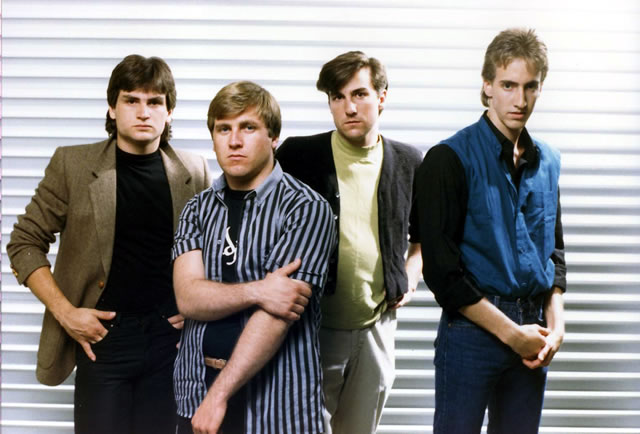
L-R: John Giali, Steve Giali, John McNamara, Glenn Holland


In a book titled God's Not Dead (And Neither Are We) by Jerry Wilson, 4-4-1's John McNamara revealed that his parents were staunch Catholics. "My mom's maiden name was McNamee and my dad's mom was O'Brien. There was a very strong east coast traditional Irish Catholic commitment in my family. I went through all the steps of Confirmation and the sacraments. Then I met the Giali brothers who lived about three houses away from where I grew up. They had been brought up Catholic, but their dad had become a believer through a charismatic movement in the Catholic Church when they lived in Chicago. Eventually, they moved to southern California, so I had four Giali boys I could play with and I was over at their house every day. Their dad had a Bible study that he actually led through the Catholic catechism. I heard about Christ in Joe Giali's living room when I was about 14 years old. That's when I first truly understood the Gospel message, and I made a commitment to Christ in 1975."

The boys made a demo tape of four songs in Holland's garage and put it in the mail to area youth pastors. It just so happened that Randy Ziegler heard it and liked it. This was a good thing since Ziegler ran a popular concert series at Calvary Chapel Costa Mesa at the time. A meeting was set up and 4-4-1 was soon on its way.  


4-4-1 playing at Calvary Chapel, Costa Mesa


The group soon entered into talks with record labels and started opening concerts for the likes of Benny Hester, Undercover and others. "The scene was on fire," Glenn Holland said in God's Not Dead. "Very special, very vibrant. We certainly weren't the first band doing this kind of stuff. Undercover, Altar Boys, Lifesavers...there was a lot of excitement, a lot of big gigs." 


4-4-1 (self-titled)
1984

Their first recorded project was completed in 1984 at Doug Doyle's 3-D Studios; it was the first album for a label called Royal Commandment (later renamed Blue Collar Records). The band and the album were well-received, especially in Southern California. "The debut made an immediate impact," blogger David Lowman remembers. Lowman lived in Southern California and says he continually pestered the program director of the local Christian radio station to try new bands. He says, "I was often rebuffed because of the rocky and edgy music, but with 4-4-1 there was an instant appreciation." Lowman says 4-4-1's new wave/new romantic sound compared favorably to groups like Duran Duran and Spandau Ballet, providing radio programmers with plenty of polished, accessible pop. "As a result, the band's singles charted heavily and their popularity grew," he wrote.


Which brings us to our featured album, 1985's Mourning Into Dancing. Produced by brothers Dino and John Elefante, Mourning Into Dancing received critical acclaim and more airplay exposure when the title track rose to #2 on national Christian rock radio charts. The guys hit the road, playing concerts at churches, schools, music clubs and festivals.

Mourning Into Dancing has been described as a big leap forward for the band - deeper lyrics, better music, stronger production. Lyrical themes tackled heavier issues and struggles that young people typically faced in the mid-80s. David Lowman wrote that dark themes such as doubt, impurity, and poor self-image were wonderfully masked in unforgettable pop music. HM's Doug Van Pelt said that on this album, 4-4-1 "crystalized that dreamy male vocalist new wave sound to perfection, adding heartfelt joy and an innocent worshipfulness that was magic." 


I recently had a chance to catch up with three of the members of 4-4-1 to get their thoughts on this now-classic recording, which begins with the title track. 

"I have a clear memory during the making of our first album," said lead guitarist John Giali. "We came to the studio with two unfinished songs along with the ones we had been playing for quite a while. Glenn asked me which of those two new ones should we do now? I suggested the one called Fish On The Car simply because it was further along in its arrangement. And so that’s what we did. That other song, temporarily sidelined that day, turned out to be Mourning Into Dancing. In retrospect, we made a wise decision because Glenn, the writer of Mourning Into Dancing, took advantage of the borrowed time to tweak and re-tweak the arrangement to perfection by the beginning of those sessions."

Singer and guitarist John McNamara also gives Holland the lion's share of the credit for the album's opening track. "It is our best and most commercially successful song ever," McNamara said, "and Glenn came up with the chord progression, the melodies, and the verse from Psalm 30 that had the phrase 'mourning into dancing.' I was blessed to be a partner with him as a songwriter for all our albums and especially for the song Mourning Into Dancing. I wrote the words and a guitar part, but it was a small contribution compared to the original idea from Glenn that ended up catapulting us to a national stage for years to come. He deserves to get a spotlight and gratitude from the rest of us in 4-4-1 for the Mourning Into Dancing song and album." 

For his part, bassist and keyboardist Glenn Holland was in a charitable mood.

"Well, John's words are very kind," said Glenn, "but he had a lyrical and melodic skill that I didn't have, and I felt that we worked well together on writing and arranging."


4-4-1 with Darrell Mansfield


In the Night is a sobering, cautionary tale that gives guest guitarist John Gaudesi a chance to make his presence known with some really nice solo work.

The drum sounds on this record are dated in a wonderful way, and keyboards are fairly prominent throughout the album. "By the end of our debut album, I had delved into synthesizers rather heavily," Glenn Holland told me. "As a band, we bought our first synth just a few months before we started recording our debut album, 441. Being a gadget guy, I really dug the tools that were coming out then. You can hear the influence on songs like Fish On The Car, In His Presence and Show Me on 441. So when we started writing and arranging what would become Mourning Into Dancing, the keyboard had moved into a more prominent position in the sound. You can hear that influence (and of bands like Simple Minds, Depeche Mode and Duran Duran) in the title track, In The Night, Is it Enough, New Land and On The Run. Only the last two songs, Jordan and Say It Right lacked a distinct or thematic keyboard part."

"Imagine my joy," Glenn continued, "as we walked into Pakaderm studios to see John Elefante's keyboard kit. Kid, meet candy store. John Elefante ended up putting together some cool synth parts for the material, including the opening melody lines of In The Night and On The Run, with his talent and array of technical tools."


Glenn Holland


Glenn said that perhaps his most difficult part of the recording process was the song Is It Enough, a superb ballad written by John McNamara. "It was me, our producers John and Dino, and our engineer, Mike Mierau in the studio to record keyboards one day," Holland remembers. "John and Dino were great producers and musicians and ultimately made the record sound fantastic. Yet, on Is It Enough, we could not agree on how the piano part should be arranged. We came from different musical perspectives and their sensibilities led them to a much more produced and, dare I say flowery rendition. I felt like I had to stand up on behalf of my absent bandmates to stay true to our new wave, punk and progressive rock roots. So my part (which John Elefante played because he's a real piano player) isn't meant to be impressive or stand out. He did a fine job with it in the end, but he certainly wasn't happy with the outcome."

Is It Enough also contained a tasteful sax solo, turned in by Scott Martin.

In His Presence shines a spotlight on bass and percussion (played by Kurt Rasmussen), and wraps up side one of Mourning Into Dancing. 

The album was recorded at Pakaderm Studios and mastered at Capitol Records by Wally Trautgott. Backing vocals were provided by Bob Loux, Greg Velasco, John Stothers, Laura Hale, and Sylvia Bronson. 


I asked John McNamara about the cover art and found out there's quite a story behind it. "Yeah, that was actually done by a friend we hired who in turn ended up hiring a USC Film School student to do the black and white photos that ended up being the cover," McNamara recalled. "The location for the photo shoot was in downtown Los Angeles because we were there for a concert. We got a gig playing there in the summer of 1985 at a huge event called the 'LA Street Scene' that was an annual event where the city shut down several blocks in the center of LA. We were on an outdoor stage at the corner of Temple and Los Angeles Street. The city booked popular musical acts, including Stevie Wonder who was on a separate stage but playing at the same time as us, so we technically had a gig with him! There were also many punk and heavy metal bands there that ended up causing riots, so the mounted police were out in force. I remember walking through about 50 horse-mounted riot police to get from our stage to our cars after we ended our gig." 


"LA Street Scene" - 1985

"We drove a few blocks to the album shoot scene area and we were really tired, hungry and a little edgy due to the riot scene," McNamara continued. "The student photographer had set up in a remote area of LA in an alley near a very bad part of the town that was mostly abandoned at that time. Today it's gentrified into apartments for 20-somethings. But back then it was an area where you did not feel safe, so that added to the stress level. Also, he had set up a very loud generator that made it difficult to hear or think. I got a huge headache and I think we looked a bit beleaguered in the photos due to the stress. After the shoot was done we walked back to our cars and one car had the window smashed out and valuables were stolen. Neither the film shoot nor the actual artwork turned out the way we had hoped." 


McNamara just shook his head and added, "It was not an award-winning cover, to say the least. It was one of those life lessons that you never forget and I certainly will remember all the details of that day for a long time."


Side two features more of the same -- bright, edgy, energetic new wave with John McNamara's lead vocal, which was right in tune with what was happening in the underground music scene in the mid-80s. Blogger David Lowman said,"McNamara had a cool swing and swagger that worked with the sound." 


Mourning Into Dancing ends with a ballad called Say It Right. I asked John McNamara to give me some background on that particular track. "Say It Right is a love song and I wrote it about a girl I was dating at the time," McNamara revealed. "I wanted to put the words 'I Love You' or something like that in the chorus, but hesitated for several reasons. One reason was that the Christian music scene at that time didn’t have any songs with that type of theme, and I, frankly, was afraid to be the first one on a commercially successful Christian album to do it. There were songs about love written for weddings or from a husband to a wife (or vice versa) in the CCM scene, but there were no songs like Say It Right. So I wrote the title as Say It Right which was a wishy-washy approach that, in my opinion, makes the song not as good. I may re-write it and re-release it on Sound Cloud soon in order to make it right."

John Giali remembers pushing Say It Right across the finish line just in time. "Typically we spent a lot of time honing our songs before heading into the studio," Giali said, "so we knew what we wanted to do once the recording process began. But, similar to Fish On The Car being half-ready before starting the first album, the last song on side two of Mourning Into Dancing, Say It Right, a beautiful song of John McNamara’s was written mostly on the spot in the reception office of the studio. I’m still captivated by the background vocal harmonies on that song that came later, and the e-bow parts Dino I worked out during the overdubs. It was a very creative time for us as John and Glenn’s writing was maturing handsomely." 


When asked how the guys felt about the finished product, Glenn Holland said, "We were very excited how the album came together. We had really good success locally with our debut, which for all it represented, was still a rookie effort and sometimes sounds that way. But Mourning Into Dancing sounded like we had some very solid songs and the means to make them come alive in the studio. There's always things you'd do differently, but thirty-plus years later it still stands up pretty well."

4-4-1 would get caught up in the second Great Restructuring on the part of Calvary Chapel's involvement with contemporary Christian music. The first one took place in the late Seventies when rock-oriented acts like Sweet Comfort Band and Daniel Amos were cut loose in favor of praise albums and children's records. This time, Calvary Chapel decided to stop promoting the underground/punk/new wave scene. The guys in 4-4-1 say that once Calvary Chapel started pulling back, and their Ministry Resource Center went away, it became very difficult for bands like theirs to be successful. Airplay suffered, tour dates were more difficult to come by, and the guys in 4-4-1 developed a decidedly negative view of the record industry--yes, even the "Christian" record industry. 

Especially the "Christian" record industry. 


John McNamara

John McNamara has some pretty strong opinions on the topic. "When we started to meet these people and talk to them about what they offered for record deals and that kind of thing, reading the contracts, we realized it's not a very fun industry," McNamara said in the book God's Not Dead. "It is very cut-throat, with a lot of jealousy and not many reassurances for the artists about what they'll be doing and when. On balance, I would say it's messed up. In some cases, extremely messed up with unscrupulous people who were screwing people and who should be put in jail. Whether they were Christian or not, what they did was horrible. They hurt people, but that was an acceptable type of behavior in the industry and more normal than not. How can an industry survive that way? It's unbelievable." 


My Friend Stephanie.
Drue Bachmann:
 center, front

Well, some would say that it didn't survive. My brother Drue Bachmann, whose largest contributions to the Christian rock music industry came through his own band My Friend Stephanie and his involvement with other bands such as The Throes and Age of Faith, makes a very good case that the once vibrant Christian rock music scene is no more. "When I was growing up in the 80s, our church youth group would go to great concerts all throughout the year," Bachmann said. "They'd often be in the biggest auditoriums in the towns. Various styles, from R&B to hard rock/alternative and everything in-between. In the 90s, when I was a part of the industry, you had even more choices. Those were the years where every city had a Christian coffee house or club-type venue where you could see all your favorite bands playing live every weekend. All of that is dead and gone now. All kids have these days is 'Winter Jam' once a year, where the bands all have to play in a single evening, festival-type setting. Atlanta alone used to support two great Christian rock music festivals, AtlantaFest and I.S. Fest, and now there's nothing. The size and magnitude of the Dove Awards, that used to be staged on a level close to the Grammys, is nothing like it used to be." 


Bachmann continued: "Back in the 80s & 90s, you could get into a Christian music scene. If you were into hip hop/rap, metal, alt/rock, stadium rock, etc., you could subscribe to fanzines, nationally published magazines and newsletters that supported those scenes. CCM, 7Ball, HM Magazine, Notebored, Harvest Rock Syndicate, Visions of Gray, Cornerstone, True Tunes News & others. None of these publications are in print anymore. The industry is dead." 

Others point to the growth of commercial worship music (there's an oxymoron for you), and say that the Christian music industry is alive and well. 

We report, you decide. 


But I digress. Back to 4-4-1...

"Completing the Mourning Into Dancing album was also the start of strains that would ultimately cause us to stop playing," Glenn Holland revealed to me. "I had made the decision prior to the record that I wanted to build a career in music," he said,"but my three bandmates all had other careers they were pursuing and the band was effectively part-time for them. I could sense my direction was not totally shared with the rest. So, when Light/Lexicon failed to pay our label owner, and Blue Collar Records folded, it seemed the signs were there that 4-4-1's days were numbered." 

"But those days were an amazing time," added John McNamara.  "And I am still great friends with John, Steve and Glenn, who I regard as true brothers in Christ." 

Without John and Steve Giali, Holland and McNamara continued on with 4-4-1 just a while longer. By 1988 they had an acoustic sound that reminded some critics of groups like Crowded House and Simple Minds. They teamed up with "Ojo" Taylor and Gene Eugene's Broken Records to release an album called Sacrifice. 


SACRIFICE by 4-4-1 (1988)

Then life changed for all involved and music took a back seat. "We all started having kids, at which point in time your world shrinks," Glenn Holland said in God's Not Dead. "Careers get more demanding; that sort of thing. It's harder to get together in a band sort of way. But we kept in touch." John McNamara added, "When Glenn comes out (Holland now lives in Texas) and we can play together, it's fun. It's like what we did when were in junior high or high school. We like to get in the garage, turn the amps on, and play."


4-4-1 played together again in 2005 at the Broken Records Reunion Concert in Southern California with Undercover, The Choir, The Altar Boys and Crumbächer (pictured above and below). 


"4-4-1 was a band for their time," wrote blogger David Lowman. "Caught squarely in the 1980’s new wave sound, they were authentic for the time. They were not behind or ahead of the times, they were squarely rooted in the day. And within that framework, they created some wonderful music and one very fine record."


"We had an uncommon experience," Glenn Holland said. "And Mourning Into Dancing allowed us to play in front of a lot of people and go to some new places. I look back upon those times with great fondness for the gift we were given and the camaraderie of my brothers."